Matthew Newton
 Krea AI
San Francisco, CA
September 2025 — Current
Joined as the fourth AI researcher on the small team behind Krea 2 and Krea 3. Worked across pretraining, midtraining, post-training, and prompt expansion, and on Krea 3's inference harness. Led data curation for both models.
Krea 2 reached the global top 10 on Artificial Analysis's text-to-image leaderboard (June 2026) and surpassed 16 million downloads across its Raw , Turbo , and Comfy-Org repositories on Hugging Face.
As of , Krea 3 Ultra ranked #5 in Artificial Analysis image editing (1151 Elo, one point behind Nano Banana 2.1), #4 in Arena multi-image editing (preliminary), and #4 in Design Arena image editing .
A few pieces of that work:
- Ran pretraining and post-training evaluations and ablations with teammates to find what actually helped.
-
Built Krea 2's prompt expander from SFT through RL, designing
text rewards to complement the team's image rewards.
- Turned moodboards into text conditioning, selecting reference images to carry texture and style.
- Added safety training to reduce unintended IP leakage and unwanted nudity while preserving accurate anatomy and artistic expression.
- Owned data curation and pipelines for both models, using midtraining to teach what pretraining had missed. Led collection of human annotation data for DPO and reward model training.
- Built embedding-search infrastructure to efficiently index our image collection and mine editing pairs for Krea 3, using open-source VLMs to generate scores and captions.
- Helped train Krea 3's VLM-based prompt expanders through SFT and RL, and contributed to the Fast and Ultra inference harnesses.
Birchwood Software Corp. 2024 — 2025
Co-founder. Built a general-purpose RAG engine with custom retrieval and ranking, delivered through Slack. Sold it to its main customer.
 Comfy Org (formerly Drip.Art)
San Francisco, CA
December 2022 — December 2024
Co-founder and CTO. Led engineering from prototype to production and handled investor relations. We moved from custom portraits to video stylization, then brought ComfyUI's original author on as a co-founder and pivoted the company to workflow infrastructure. Stayed on as an advisor after leaving the CTO role.
- Led pre-seed fundraising efforts, securing funding from investors to scale the company through multiple product iterations and strategic pivots while maintaining technical leadership responsibilities.
- Developed evaluation frameworks for personalized model quality and user preference alignment, analyzing engagement patterns across 10k+ users to identify market opportunity in workflow infrastructure over consumer generation.
- Managed a small team of full-time engineers and contractors, across full-stack development, MLE, and DevOps, through regular 1:1s, reviews, and career development planning.
- Built multi-tenant ML serving infrastructure supporting hundreds of custom models concurrently, with intelligent caching and batching for personalized AI-generated content.
- Architected multi-cloud GPU orchestration system across AWS, Lambda Labs, and CoreWeave with cost-optimized scheduling and multi-gigabyte model checkpoint management.
- Designed automated training pipelines for user-specific model fine-tuning (LoRAs/Dreambooth), enabling rapid personalization of Stable Diffusion models.
- Maintained same-day fine tuning delivery and sub-5 minute subsequent generation SLAs while optimizing for cost efficiency at scale.
- Helped interview and recruit a talented team.
- Skill highlights: Python, PyTorch, Stable Diffusion, ComfyUI, Kubernetes, Firebase, PostgreSQL, Multi-cloud GPU Infrastructure, ML Model Serving, Engineering Management
 Meta
Palo Alto, CA
May 2022 — December 2022
Developed and optimized AutoML systems on the Ads Core ML team, maintaining hundreds of advertising models through automated retraining and performance improvements.
- Enhanced model feature selection by extending importance metrics to automatically identify and remove performance-degrading features.
-
Contributed to cross-team AutoML optimization:
- Developed attribution frameworks to isolate performance gains from different automated approaches.
- Accounted for confounding factors across model scales and training regimes.
- Skill highlights: Python, PyTorch, AutoML, Machine Learning Infrastructure, Model Optimization
 Google
Mountain View, CA
December 2016 — April 2022
Gboard — Federated Analytics and Machine Learning July 2019 — April 2022
Worked with international teams on private federated learning for Gboard. We discovered emerging words like “vaxxed” without centrally logging keyboard activity, expanding the vocabulary of typing and spelling models so they could recognize and predict new words while preserving privacy. This work also improved emoji search and surfaced sticker recommendations.
-
Designed, implemented and shipped our team's first
on-device personalized models.
- Shipped two iterations of sticker pack recommendations using collaborative filtering, one using item-item collaborative filtering based on privately aggregated item co-share data, and another using user-item embeddings.
- Improved engagement with sticker recommendations and helped establish federated model evaluation and methods for diagnosing data corruption.
- Developed new federated tasks to securely aggregate heavy-hitter data in anonymized batches, using Invertible Bloom Lookup Tables (IBLT), secure aggregation protocols, and differential privacy.
- Used heavy-hitter data to improve the quality of typing language models, emoji search, and sticker suggestions.
- Built custom TensorFlow ops to run SecAggIBLT efficiently on Android phones through TensorFlow Lite.
- Identified, diagnosed, and resolved barriers to private heavy hitter tasks outside my direct team.
- Interviewed multiple software engineer candidates, mentored team members through documentation and 1:1s, presented in internal tech talks on collaborative filtering.
- Skill highlights: Python, TensorFlow, TensorFlow Federated, Java, C++, IBLTs, Flume, Apache Beam, data pipelines, differential privacy, secure aggregation, collaborative filtering
Google Search — Search Frontend December 2016 — July 2019
Built shared frontend infrastructure for Google Search, helping teams ship features and speeding up billions of search result pages served each day.
- Ran experiments and analyzed performance metrics to improve JavaScript execution and rendering on mobile Search.
- Wrote efficient JavaScript libraries and polyfills for the Google search results page used by virtually every mobile query. Supported multiple accessibility modalities and browsers as old as iOS 8 Safari.
- Increased search developer velocity by developing easy-to-use APIs around async requests, without sacrificing performance for the end user. These libraries power the async experience of several search verticals, such as Jobs Search.
- Taught the frontend portion of Search Features Bootcamp three times, developing course materials and labs and supporting engineers as they built Search features.
- Supported a cross-platform component library for Google Search, which served mobile web surfaces and native mobile views in the Google Assistant on both Android and iOS.
- Planned, pitched and directly managed 2 STEP interns on projects around client side rendering on the search results page, providing daily mentorship, code reviews, and career guidance that led to full-time offers for both interns.
- Skill highlights: JavaScript, TypeScript, HTML/CSS, Java, Python, Objective-C, Protobuf, Blaze/Bazel, People Management, Mentorship
 Apple
Cupertino, CA
May 2013 — December 2016
Fullstack engineering for the Apple Instructional Design department, including team leadership responsibilities. This ranged from internal tooling for authors and localizers, to creating new user-facing instructional experiences ahead of product launches.
- Created a custom CMS solution to manage authoring, localization and review of content for the Tips app.
- Translated designs to localizable HTML/CSS/JavaScript for "Quick Tours," interactive introductions to macOS or first party apps with over 20 supported languages. (e.g., help.apple.com/osx-mavericks/whats-new).
- Led exploratory project for a help chat bot to recommend relevant support content, directly managing an intern and coordinating with cross-functional stakeholders.
- Mentored junior engineers on web localization best practices, and completed Apple University Management Training.
- Skill highlights: JavaScript, CSS, Ember.js, Node.js, Objective-C, Postgres, Web Localization
Education
Rochester Institute of TechnologySeptember 2009 — May 2013
Bachelors of Science in Computer Science, from Rochester Institute of Technology. Minors in Mathematics and Economics.
Just For Fun
ARC Challenge — Discrete Diffusion–Based Reasoning 2025
Hacked Qwen3-8B to solve ARC puzzles by filling in the easy parts first, instead of working in typewriter order. Built the training and evaluation pipeline and found that better pixel accuracy didn't mean more solved puzzles. Read the technical write-up Discuss on Hacker News
Diffusion model solving an ARC challenge task, progressively gaining confidence in token predictions from noise to final pattern completion.
Technical Blog
Writing about machine learning experiments and practical AI engineering, including what we learned when a simple document-reading agent outperformed our RAG pipeline. Read my blog
Blaze/Bazel Build Notifying Widget 2017
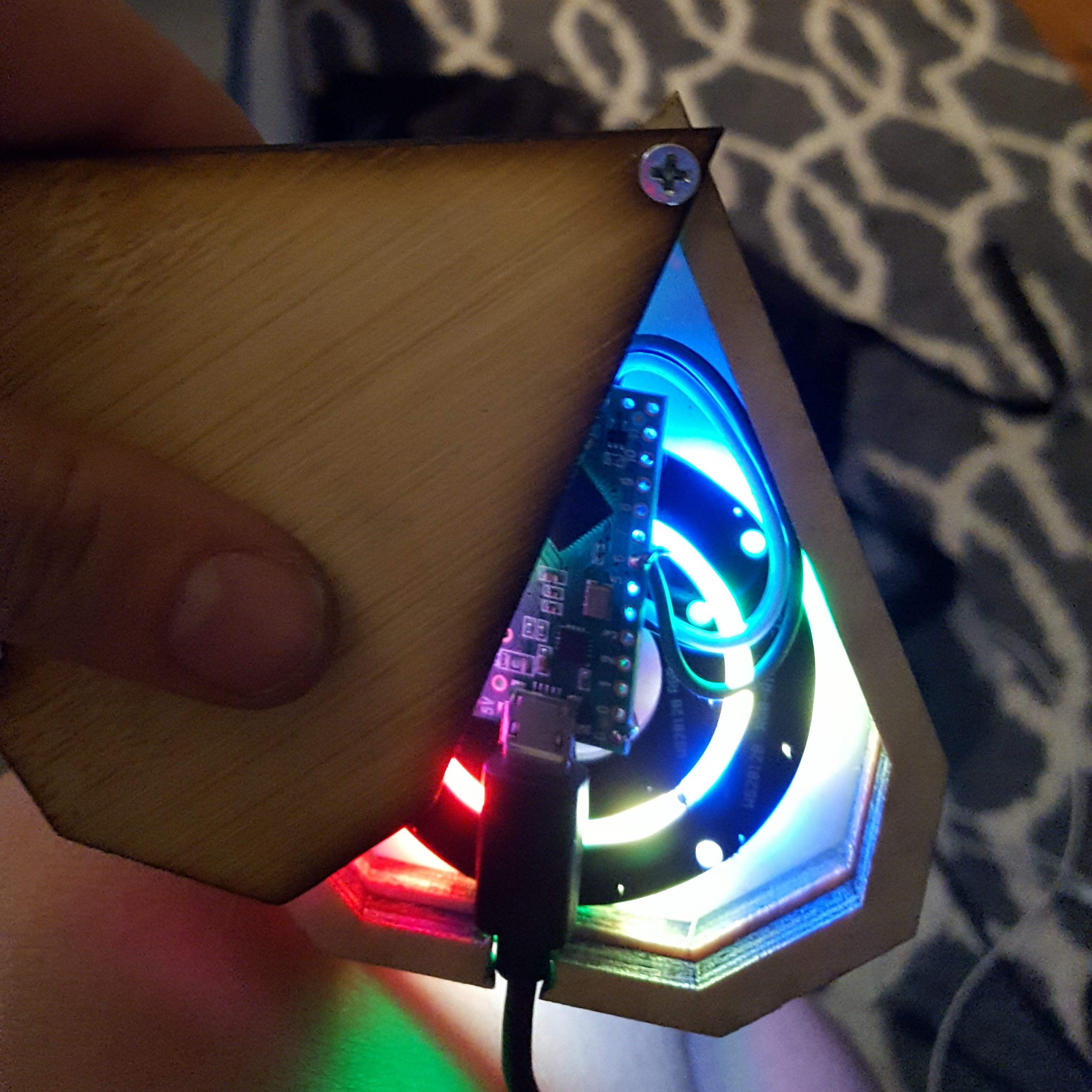
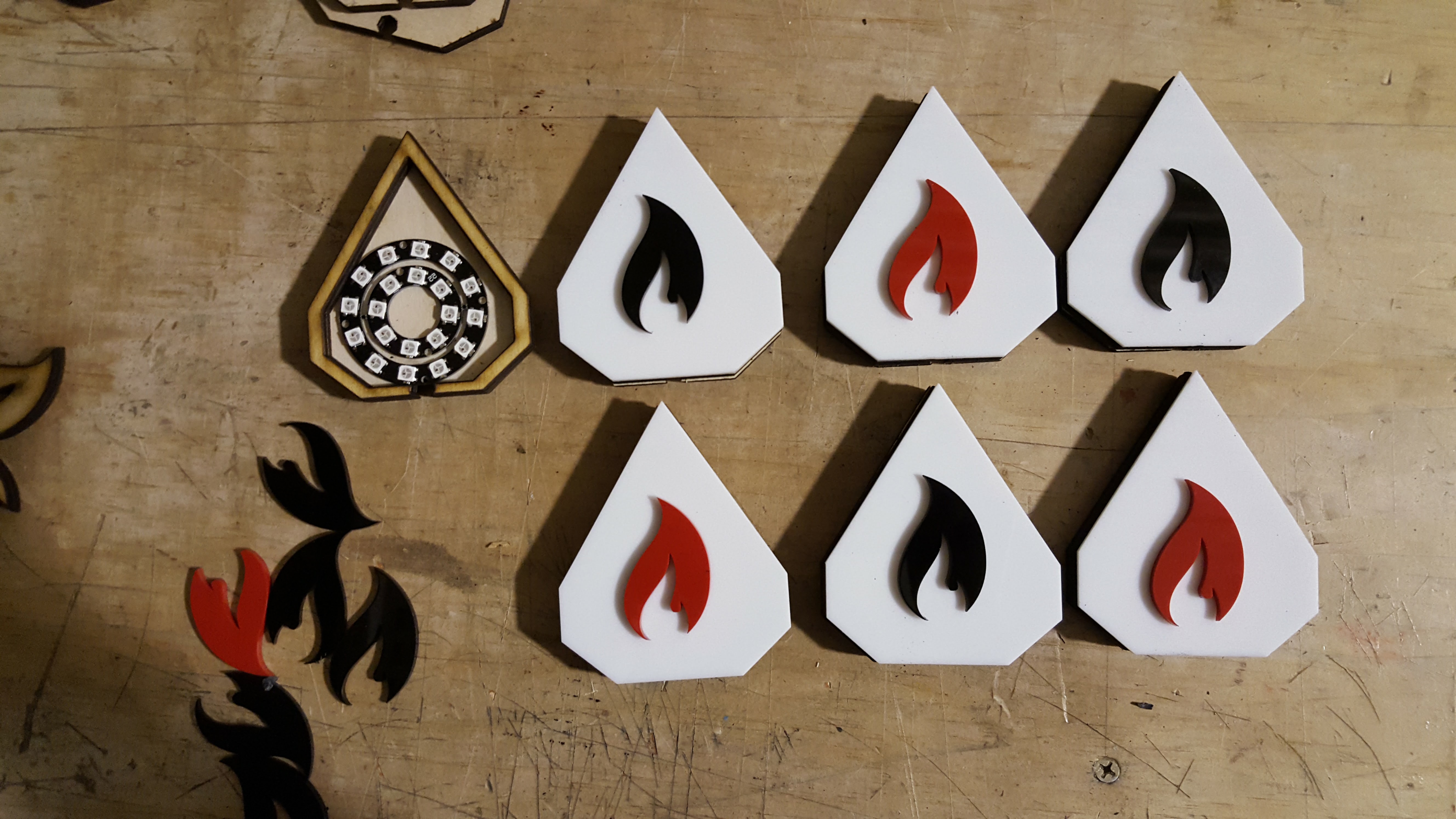
When I joined Google Search, I found that I often missed when the build was done, especially if it had failed early. A cold build could take 30-45 minutes even on my specialty machine with 12 cores and 128gb of ram, which meant context switching whenever blaze's cache was too old. So I built this LED notification widget to let me know when the build had finished with attention-grabbing lights. I provided parts to my coworkers in my team and taught a quick class on assembling / programming the microcontroller as a blaze status indicator.
This widget connects to the host machine over usb and was posted somewhere noticeable in my office. I wrote a small python daemon for the build machine that polls my blaze build server for updates in its status. When it detects a change, it pushes the updated status over usb to a Teensy microcontroller, which controls a ring of ws2812b LEDs, pulsing all red for failure or all green for success. The walls and the back of the enclosure are laser cut wood pieces, and the front is white acrylic to diffuse the LEDs inside. The back wood panel is held on by a single screw that, when loosened, allows the panel to swivel open for servicing.
Kinect the Dots 2015
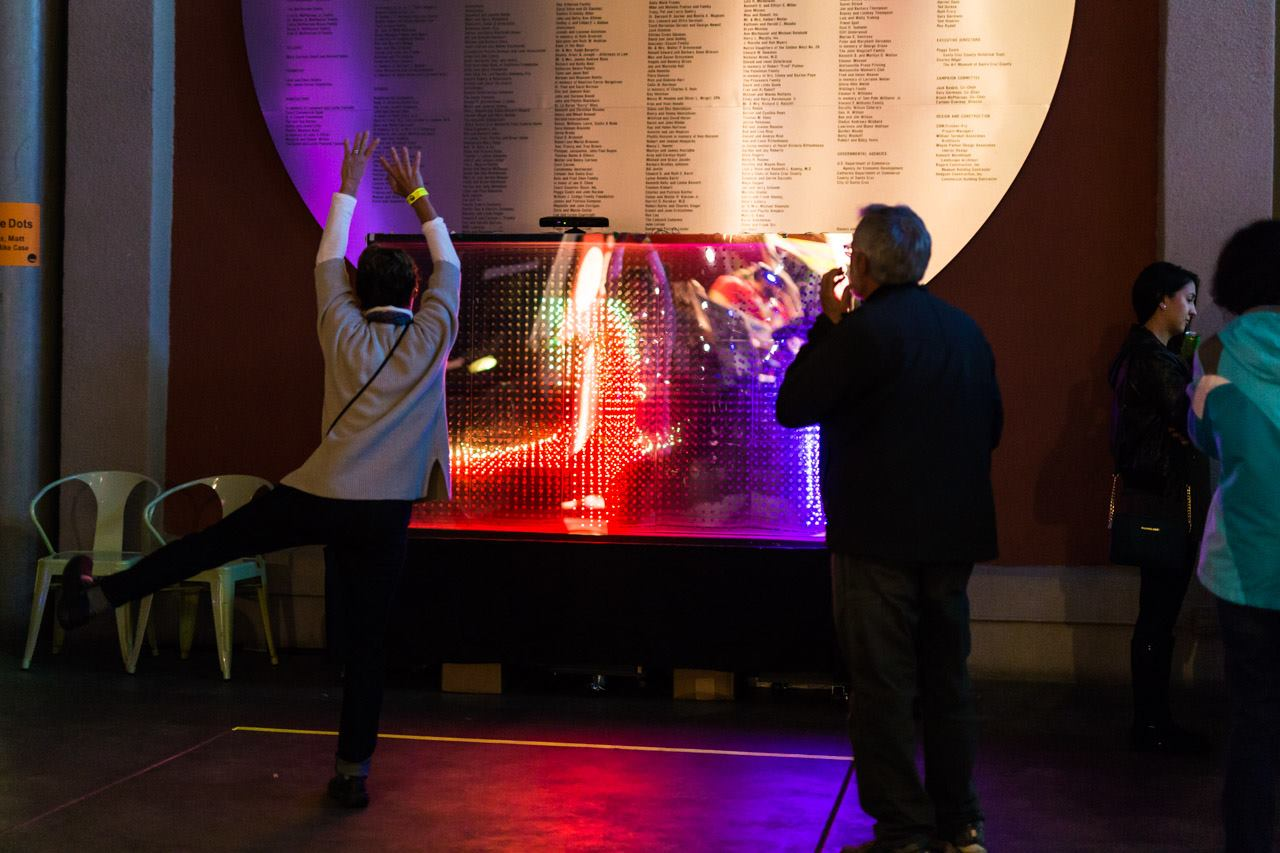
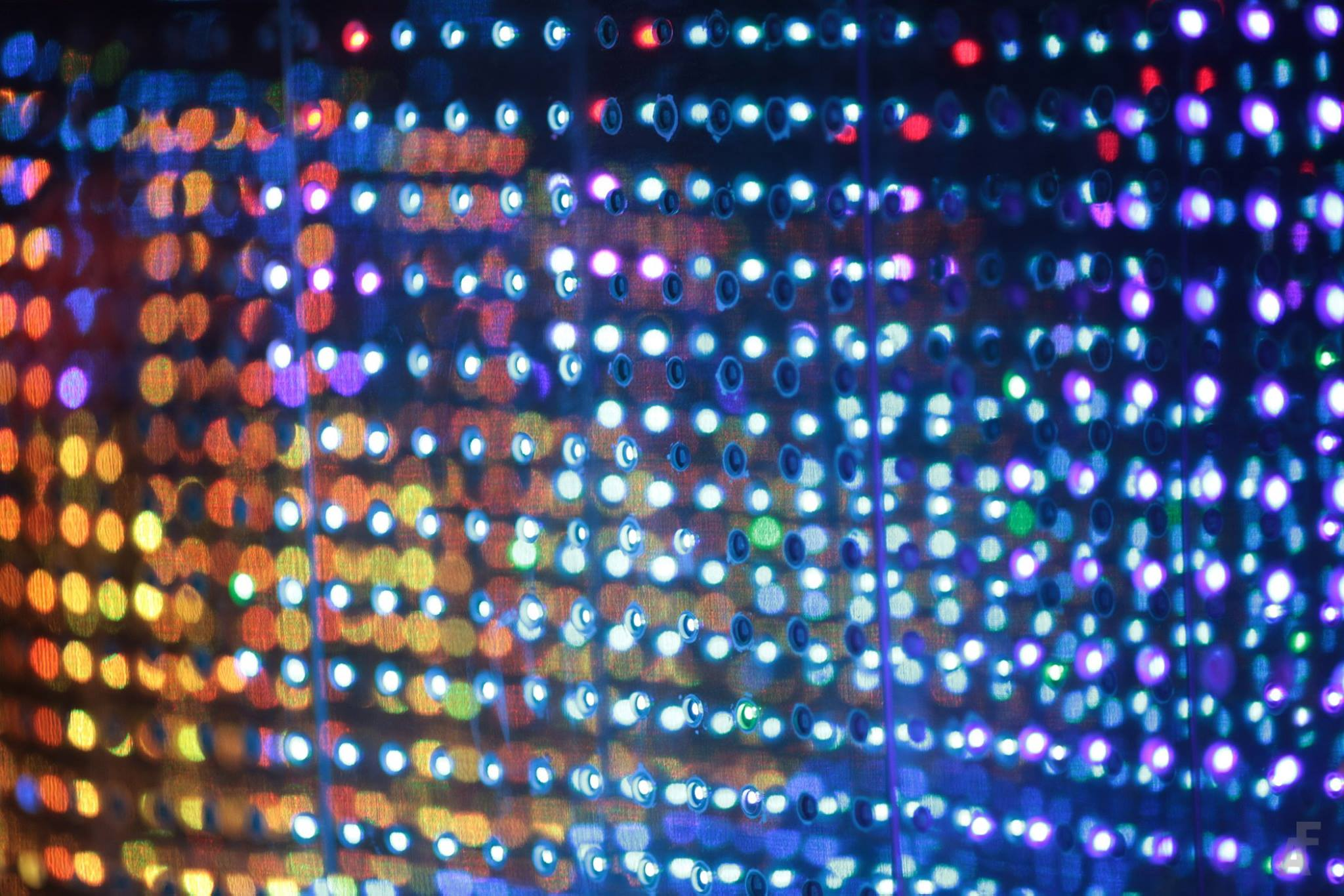
Made an electronic art installation called 'Kinect the Dots', a large-scale grid of approximately 1,900 LEDs which displays RGB silhouettes of nearby people in real time. This has been showcased at the Bay Area Maker Faire (received 2 editor's choice awards), )'( and Santa Cruz Glow.
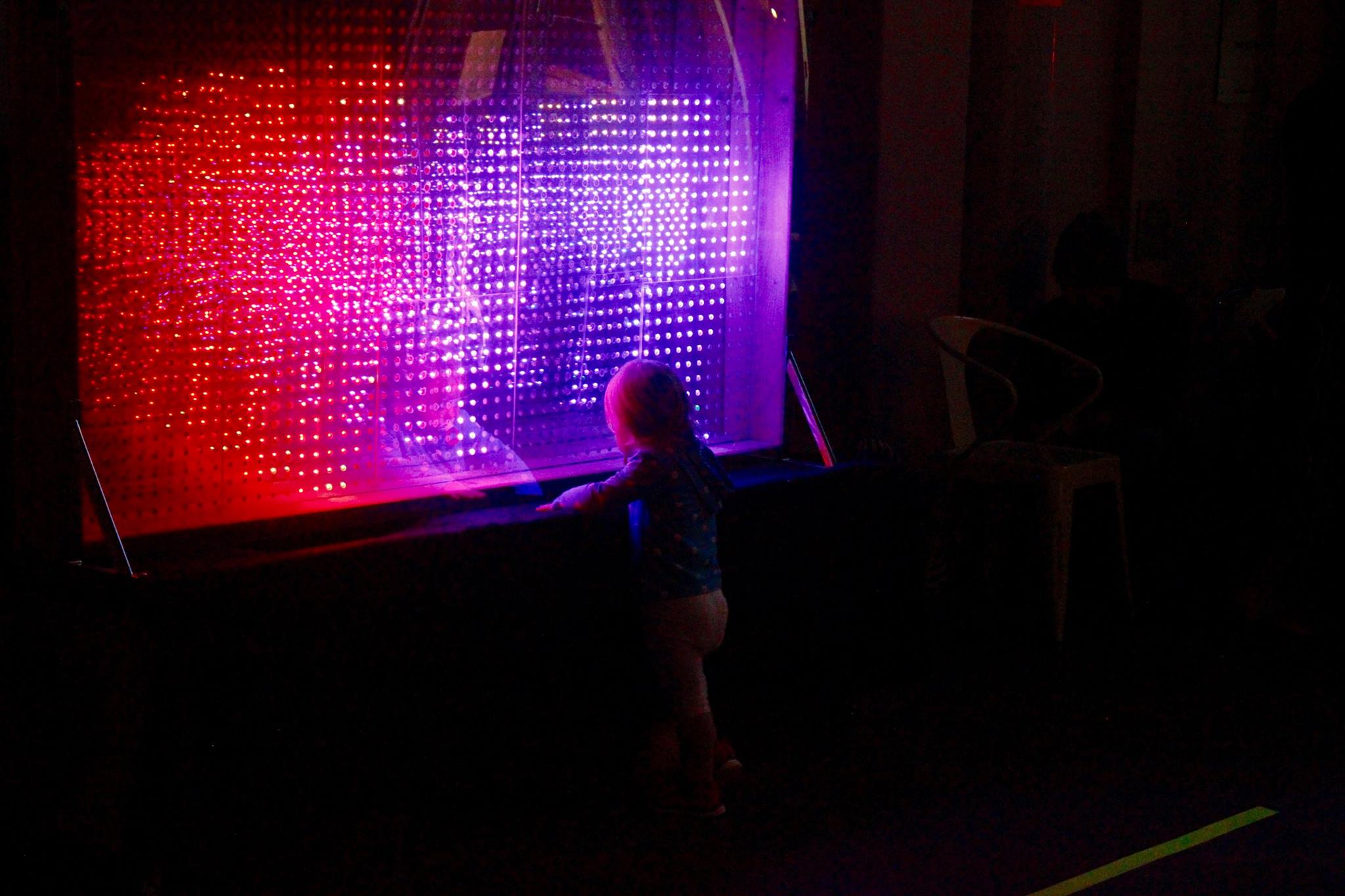
C++ code interprets Kinect point cloud data on MacBook, which finds people in the scene and pushes display data to C program on a Teensy microcontroller. The Teensy drives the RGB LEDs as fast as it receives frames from the MacBook. The LEDs are behind holes in mirrored acrylic, and in front of that mirror is a two-way-mirrored acrylic sheet, which bounces some of the light back into the mirrored acrylic creating an "infinity mirror" effect.
I got my hands dirty on every layer of the stack, starting with fleshing out the overall vision for the art, architecting the different parts, sourcing materials, power calculations, machining, assembly, microcontroller code, wiring, developing a wire format over usb, and the c++ code that used Prime Sense's pose detection models to find people in the scene.